2007년 아트인컬처 7월호
영은미술관 개인전시 리뷰

영은미술관 개인전시 리뷰
객관적인 자연, 혹은 도시의 풍경 그 자체는 그림이 되지 않고, 시가 되지 않는다. 우리가 풍경을 바라보는 것은 그저바라보는 것이 아니라 풍경 속에 담겨져 있는 사물의 표정을 읽는 것이며 느끼는 것이다. 바라보는 사람의 의식이 개입되지 않으면 풍경은 그저 자연 그 자체(nature itself)로 남아있을 뿐이다. 의식의 개입이라는 점에 주목하면서 조경학자 강영조는 풍경이란 인간의 외부에 있는 객관 세계 그 자체가 아니라 그것을 전유하는 ‘인간과 세계와의 관계’라고 정의 한다. 그 관계의 핵심에는 잃어버린 낙원에 대한 동경이 깃들어 있다. 또 풍경 그 자체의 실존보다 ‘관계’가 중요하다는 것은 풍경 전유 방법의 다양성을 가능하게 한다.
[초원] [검은 숲] [어떤 날] [하늘 한 조각]등의 제목에서 암시되는 바처럼 이경의 그림은 풍경화의 일종이다. 이경의 풍경화는 이미지의 홍수로 표현되는 현대의 미디어 환경에서 존재 가능한 풍경화의 한 갈래를 보여준다. 그가 그리는 풍경은 구체적인 장소성이 누락되어 있다. 세계 그 자체는 가장 최소화 지점으로 환원되고 풍경감상자와 ‘세계와의 관계’가 전면에 부각된다. 전통적인 관점에서 풍경감상자와 세계의 관계는 풍경 감상의 기점인 점경인물의 설정으로 요약될 수 있다. 그러나 그의 그림 속에는 역설적이게도 풍경의 구체성과 점경인물이 모두 소멸되고, 세계와의 관계 자체 즉 풍경감상 자체가 가장 중요한 테마로 부각된다.
작가가 내세우는 전시의 제목들은 구체성이 소멸된 풍경감상자와 세계와의 관계에 대한 이해를 돕는다. 2006년 [파라다이스]라는 제목으로 전시회를 가진 이후 이경의 관심사는 여전히 파라다이스이다. 누가 낙원에 가보았는가? 혹은그곳에 갔다가 돌아와서 낙원의 모습을 전하는 사람이 있던가? 노자와 장자의 시대에나 가능했던 이야기이다. 어느시대나 낙원의 모습은 그것을 꿈꾸는 사람들의 몫이다. 그가 발견한 낙원은 먼 곳에 있지 않다. 일상의 한 조각이거나인터넷을 통해서 본, 가 보지 못한 먼 나라의 풍경이다. 풍경감상자의 구체적인 모습이 드러나기에 너무 편협하거나체험한 적이 없는 공간들이다. 풍경의 구체성이 부차시되고 풍경에 대한 감상, 세계와의 관계가 전면에 부각되는 이유이다. 낙원의 구체성은 사라졌으나 낙원에 대한 갈망이 화면을 지배하고 있다.
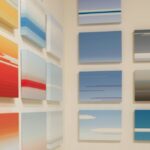
이경이 풍경을 전유하고 정립하는 방법은 바로 색채이다. 잘 정돈된 화면은 여러가지 색채의 병렬과 조화 속에서 풍경의 느낌을 전하고 있다. 멀리서보면 가로의 색띠들이 서정적인 풍경의 느낌을 전하고 있다. 작가가 뽑아내는 색채의스펙트럼은 무한하다. 인간의 감정 역시 무한하다. 다만 그것을 묘사할 수 있는 언어가 부족할 뿐이다. 텍스트적 설명을 넘어서는 직관의 풍경이자 정교한 정서의 풍경이다. 즉 이번 영은미술관 전시의 제목에서 암시된 바와 같이 ‘평등한 매력’을 가진 색채들의 조화로운 세계가 작가가 느낀 파라다이스이다. 독자적인 아름다움을 가진 색채들이 아무런우열 없이 공존하는 공간 자체가 작가가 꿈꾸는 낙원이다.
가까이 가서보면 그 색띠들은 작가의 붓질이 제거된 정교한 화면을 이루고 있다. 색띠들은 정교하게 모듈(module)화된 직사각형의 형태처럼 인지되기도 한다. 이것은 우리가 사물의 구조를 읽어내는 새로운 방식인 픽셀의 개념이 아니다. 그것은 그녀가 오랫동안 풍경을 그리면서 연구해낸 방법, 즉 풍경에 대한 기하학적 해석의 일환이다. 기하학적인질서에 대한 탐닉은 사실 정반대로 세상의 혼란에 대한 염오를 표현한다. 토마스 모어의 [유토피아], 캄파넬라의 [태양의 나라] 역시 기하학적인 조화로 가득 차 있었다. ‘평등한 매력’을 가진 색띠들은 낙원에 대한 강렬한 열망의 반어적표현이다. 사람이 사라진 풍경화는 색띠들이 질서정연한 조화를 이루고 있다. 여기서 비롯된 시각적인 평온함과 고요한 조화가 전시장을 지배하고 있었다.
이경의 정교한 화면은 강렬한 형상으로 가득 찬 대형화면이 지배하고 있는 최근 전시 상황에 익숙해진 관객들에게는지나치게 섬세해 보인다. 그러나 모두 같은 노래를 부를 수는 없다. 그것은 또 다른 부자유의 증표일 뿐이다. 모든 색들이 ‘평등한 매력’을 뿜어내는 것이 이경의 화면의 장점이다. 모든 그림들에게 평등한 매력을 느낄 수 있는 성숙함이우리 미술계의 장점이 되길 바란다.
2007 © 이진숙(독립큐레이터)
Art in Culture, July 2007
Young Eun Museum of Contemporary Art, Solo Exhibition Review
Objective nature, or the cityscape itself, does not become a painting, does not become poetry. When we look at landscape, we are not just looking, but reading and feeling the expressions of objects contained within the landscape. Without the intervention of the consciousness of the viewer, landscape merely remains as nature itself. Focusing on the point of consciousness intervention, landscape architect Kang Young-jo defines landscape not as the objective world outside of humans itself, but as the ‘relationship between humans and the world’ that appropriates it. At the core of that relationship lies a longing for the lost paradise. Also, the fact that ‘relationship’ is more important than the existence of landscape itself enables diversity in methods of landscape appropriation.
As suggested by titles such as [Grassland], [Black Forest], [A Certain Day], and [A Piece of Sky], Kyong Lee’s paintings are a kind of landscape painting. Kyong Lee’s landscape paintings show one branch of landscape painting that can exist in the modern media environment expressed as a flood of images. The landscapes he paints lack specific sense of place. The world itself is reduced to the most minimal point, and the ‘relationship with the world’ between the landscape viewer and the world is brought to the forefront. From a traditional perspective, the relationship between landscape viewer and world can be summarized as the establishment of staffage figures, which are the starting point of landscape appreciation. However, paradoxically, both the specificity of landscape and staffage figures disappear in his paintings, and the relationship with the world itself—that is, landscape appreciation itself—emerges as the most important theme.
The exhibition titles the artist puts forward help us understand the relationship between the landscape viewer, whose specificity has disappeared, and the world. Since holding an exhibition titled [Paradise] in 2006, Kyong Lee’s interest remains paradise. Who has been to paradise? Or has anyone gone there and returned to convey the appearance of paradise? This is a story only possible in the era of Laozi and Zhuangzi. In any era, the appearance of paradise belongs to those who dream of it. The paradise he discovered is not far away. It is a fragment of daily life or a landscape of a distant country seen through the internet but never visited. These are spaces too narrow to reveal the specific appearance of the landscape viewer or spaces never experienced. This is why the specificity of landscape is made secondary and appreciation of landscape, the relationship with the world, is brought to the forefront. Although the specificity of paradise has disappeared, the longing for paradise dominates the screen.
The method by which Kyong Lee appropriates and establishes landscape is precisely color. The well-organized screen conveys the feeling of landscape through the juxtaposition and harmony of various colors. Viewed from afar, horizontal color bands convey a lyrical landscape feeling. The spectrum of colors the artist extracts is infinite. Human emotions are also infinite. It is just that there is insufficient language to describe them. It is a landscape of intuition and a landscape of refined emotion that transcends textual explanation. In other words, as suggested by the title of this Young Eun Museum exhibition, a harmonious world of colors with ‘equal attraction’ is the paradise the artist feels. The space itself where colors with independent beauty coexist without any superiority or inferiority is the paradise the artist dreams of.
Viewed up close, those color bands form a refined screen from which the artist’s brushstrokes have been removed. The color bands are sometimes perceived as precisely modularized rectangular forms. This is not the concept of pixels, which is our new way of reading the structure of things. It is a method she has researched while painting landscapes for a long time, that is, part of a geometric interpretation of landscape. The indulgence in geometric order actually expresses, conversely, disgust at the world’s chaos. Thomas More’s [Utopia] and Campanella’s [City of the Sun] were also filled with geometric harmony. The color bands with ‘equal attraction’ are an ironic expression of intense longing for paradise. In landscapes where people have disappeared, color bands form orderly harmony. The visual tranquility and quiet harmony arising from this dominated the exhibition space.
Kyong Lee’s refined screens appear excessively delicate to audiences accustomed to recent exhibition situations dominated by large screens filled with intense images. However, not everyone can sing the same song. That would only be another sign of unfreedom. The advantage of Kyong Lee’s screens is that all colors emit ‘equal attraction.’ I hope that the maturity to feel equal attraction to all paintings becomes an advantage of our art world.
2007 © Lee Jin-sook (Independent Curator)
 The fascination of equilibrium – Solo Exhibition, Youneun Museum of Contemporary Art, 2007