
작업노트
Artist's Note
작업노트
나는 자연의 한 조각, 디지털을 포함한 일상의 단편, 시간의 흐름, 감정의 정화 등에 매료되었지만 내가 가장 흥미를 느끼는 지점은 그 색들이 왜 나에게 감흥을 불러일으킬까를 스스로 질문하는 것이다. 그 해답을 찾기 위한 예술적 모색을 나는 형용사로서의 색채라는 개념과 그로부터 파생된 회화적 형식실험으로 구현하고 있다.
이번 개인전을 통해 나는 (마음의) 상태변화 시리즈와 기존의 드로잉을 보다 확장한 Emotional Color Field 시리즈, 그리고 완벽한 우연 등 새롭게 탐구한 회화 작품을 전시한다.
ᅠ
(마음의) 상태변화/Emotional Color Change Series
상태변화 시리즈는 외부 환경의 시각적 감흥을 색과 언어의 조합으로 만든 “형용사로서의 색채”를 사용하고 있다. 두세 가지 색이 캔버스 끝에서 시작하여 서로 섞이면서 또 다른 색으로 변화하는 과정을 5mm를 최소 색면으로 시작하여 1mm씩 점증하는 수평의 색면으로 구성된다. 내가 명명한 색의 이름은 캔버스 옆면에 손으로 적었다.
시리즈 전체의 제목은 만남과 이별이 빠르게 교차하는 기차역이라는 장소의 혼란스러운 감정의 상태를 그린 미래파 작가 움베르토 보치오니의 마음의 상태 시리즈(Umberto Boccioni, States of minds Series)에서 영감을 얻었다.
나의 작품에서는 하지만 의도적으로 수평의 색면을 쌓아 이 감정에서 저 감정으로 자연스럽게 마음이 바뀌는 과정을 천천히 보여줌으로써 과잉된 감정의 혼돈을 진정시키고 싶었다. 내가 사용하는 형용사로서의 색채는 모두 나 개인의 감정을 담고 있지만 시간과 공간에 따라 그 색감정은 변화하기 마련이다. 그 변화의 섬세한 과정은 나 자신조차 인식하기 어렵다. 화려한 마음의 상태에서 무상한 감정이 드는 순간이 있다면, 순식간일 수도 있고 매우 느리게 변해갈 수도 있겠다. 그런 의미에서 내가 미처 인식하지 못하고 있던 어떤 감정들, 혹은 언어화하지 못한 색상들을 캔버스 위에 펼쳐서 보여주고 있는 것이다. 이 시리즈는 그래서 아직 형용사로 명명되지 않은 감정의 색면이 그림 전체를 아우르는 감정의 풍경화라고 할 수 있다.
Emotional Color Field Series
사계절의 변화가 뚜렷한 나의 환경에서 시간의 흐름은 나의 일상과 감정을 지배한다. 차가운 얼음이 피부를 스치는 듯한 겨울과 뜨거운 스팀의 열기가 공기 중에 가득한 한여름의 무더위는 평온을 찾고자 하는 마음과는 달리 드라마틱한 감정의 소용돌이를 마주칠 때가 있다. 그런 날 나는 이 시리즈 작업을 위해 책상 위에 형용사로서의 색채 컬러칩을 펼쳐 놓는다.
색상에 민감하면서도 형용사 단어와의 연관성을 고려하며 10개의 색을 선택한다. 이 색의 조합은 전적으로 우연적이다. 하지만 이 우연은 나 개인의 감정 상태뿐만 아니라 계절, 날씨, 사회적 상황에 따라서도 다르게 조합되도록 의도되어 있다. 이 작업에서 내게 중요한 점은 그 순간의 정서적 진정성뿐이다.
그 선택된 조합을 종이 위에 그리다가 이번엔 큰 캔버스 화면 위에 동일한 포맷으로 그렸다. 180cm는 나의 키보다 커서 내가 올려다봐야 하는 크기로 내가 그 앞에 서 있을 때 나의 시선을 온전히 채우는 크기다. 그림에 가까이 다가가면 색면 왼쪽엔 해당 형용사 단어가 양각의 물감으로 도드라져 있다. 10개 단어와 색의 조합은 표현주의적 과잉을 배제한 채 캔버스 위에서 균일한 공간을 차지한다.
완벽한 우연 (perfect coincidence)
부제: 작업중인 팔레트 Working palette
작업에 대한 어떤 의도나 계획, 구상 없이 완벽한 우연을 발생시킬 수 있을까? 그 우연을 통해 내가 미처 상상하지 못했던 새로운 감각을 그려낼 수 있을까?를 고민하던 중 작업대 위 언제나 물감을 섞을 때 사용하는 나의 팔레트가 눈에 띄었다. 그곳엔 정의하지 못한 색의 기록이나 형용사로서의 색채-형용사를 찾기 위해 섞고 있던 무정형의 혼합색과 물감나이프의 흔적, 키우는 고양이가 흘려버린 물감통에서 쏟아진 얼룩 등이 남아있었다. 예상하지 못한, 생생하게 살아있는 순수한 감각이 떠올랐다.
Jean Arp가 우연의 법칙에 따른 콜라주 작업에서 색종이를 찢어 공중에서 뿌린 행위를 통해 새로운 감각의 구성을 만들어냈다면, 나는 작업대 위에 팔레트 대신 캔버스 천을 깔아놓고 그 위에서 어떤 계획도 없이 작업 중인 물감들이 만들어내는 임의의 구성을 통해 완벽한 우연을 실험한다. 사건은 작업대 위에서 발생하고 나의 예측불가능한 행위로 펼쳐지는 임의의 사태를 나는 나의 감각과 색, 그리고 우연의 상호작용으로 이해한다.
2023, ⓒ 이경
Artist's Note
Work Notes 2023
I am captivated by fragments of nature, snippets of daily life including the digital, the passage of time, and the purification of emotions. Yet what interests me most is questioning why these colors stir my emotions. To find that answer, I pursue artistic exploration through the concept of color as an adjective and the resulting painterly formal experiments.
Through this solo exhibition, I present the Emotional Color Change Series, an expansion of my existing drawings, the Emotional Color Field Series, and newly explored paintings such as Perfect Coincidence.
ᅠ
Emotional Color Change Series
The State Change series employs “color as an adjective”—a combination of color and language created from visual impressions of the external environment. Composed of horizontal color fields starting at a minimum size of 5mm and incrementing by 1mm, the process depicts two or three colors beginning at the edge of the canvas, blending into each other, and transforming into another color. The names I gave to these colors were written by hand on the side of the canvas.
The series’ overall title draws inspiration from Futurist artist Umberto Boccioni’s States of Mind series, which depicted the chaotic emotional state of a train station—a place where encounters and farewells rapidly intersect.
In my work, however, I deliberately stacked horizontal color planes to slowly reveal the process of the mind shifting naturally from one emotion to another. This was an attempt to calm the chaos of excessive emotion. The colors I use as adjectives all carry my personal feelings, yet these emotional hues inevitably change with time and space. The delicate process of that change is difficult even for me to perceive. If there is a moment when fleeting emotions arise from a state of vivid feeling, it might be instantaneous or it might change very slowly. In that sense, I am unfolding and revealing on the canvas certain emotions I hadn’t yet recognized, or colors I couldn’t put into words. This series can thus be described as an emotional landscape painting where color fields of feelings not yet named by adjectives encompass the entire picture.
Emotional Color Field Series
In my environment, where the four seasons change distinctly, the passage of time governs my daily life and emotions. Winters where cold ice seems to brush against the skin, and the sweltering heat of midsummer where the air is thick with the heat of hot steam—these can sometimes bring dramatic emotional whirlwinds, contrary to the desire to find peace. On such days, I spread out color chips representing colors as adjectives on my desk for this series.
Sensitive to color yet mindful of its association with adjectives, I select ten hues. This combination is entirely coincidental. Yet this coincidence is intentional—it varies not only with my personal emotional state but also with the season, weather, and social context. What matters most to me in this work is the emotional authenticity of that moment.
After drawing the selected combination on paper, I then painted it on a large canvas in the same format. At 180cm, it’s taller than my height, forcing me to look up. It’s a size that completely fills my field of vision when I stand before it. Approaching the painting, the corresponding adjective word stands out in raised paint on the left side of the color field. The ten word-color combinations occupy uniform space on the canvas, free from expressionistic excess.
Perfect Coincidence
Subtitle: Working Palette
Can perfect coincidence occur without any intention, plan, or conception for the work? While pondering whether that coincidence could paint new sensations I hadn’t imagined, my palette—always used for mixing paint on the workbench—caught my eye. There remained traces of undefined color records, amorphous mixed hues blended in search of color-adjectives, palette knife marks, and stains spilled from paint tubes knocked over by my cat. An unexpected, vividly alive, pure sensation surfaced.
If Jean Arp created new sensory compositions by tearing colored paper and scattering it through the air in his collage work governed by the laws of chance, I lay canvas cloth over my workbench instead of a palette. There, I experiment with perfect chance through the arbitrary compositions formed by paints working without any plan. The event unfolds on the workbench, and I understand the arbitrary situation that unfolds through my unpredictable actions as an interaction between my senses, color, and chance.
2023, ⓒ Lee Kyong
Related Exhibition
Color as adjective 9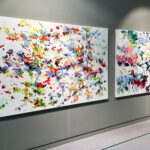 , Artspace KC, 2023, Seoul, Korea