풍경의 카덴짜
류지연(국립현대미술관 학예연구사)

류지연(국립현대미술관 학예연구사)
한편 섬세하게 재단된 색띠의 배합과 매끄러운 마무리 처리는 그녀의 작품에서 볼 수 있는 특징이다. 하지만 작품 표면에 나타나는 독특한 질감은 관람객으로 하여금 작가의 개성을 느끼게 한다. 색띠 경계사이 예리하지만 약간은 거칠게 처리된 가장자리가 선인지 또 다른 재료인지 혹은 의도된 질감처리인지 명확하게 알 수는 없다. 여기에서 중요한 점은 그러한 독특한 경계선의 처리가 작가 손길의 흔적으로서 작업과정을 짐작함과 동시에 화면 자체의 촉각적인 감각을 환기시키고 있다는 점이다.
작가는 색채가 가진 상징성을 통해 대기와 빛의 스펙트럼을 나타내고 있으며 그 결과 그녀의 풍경화는 작가의 감성에 의해 추출된 주관적인 풍경이다. 작가는 한동안 개인의 삶에 대한 사유를 외부로 표출했던 작업에 몰두하였다. 하지만 이전 작업과는 달리 이번 전시는 외부세계에 대한 작가의 상상을 보여주고자 한다. 혼란한 현실의 틀 속에서 자신에게집중하여 작품을 이루어 나가는 과정 자체는 정신적인 여행과 같다.
풍경이 흔한 주제로 간과될 수 있으나 각각의 자연이 저마다의 모습을 띄고 있듯이 모두들 자연, 풍경에 대한 저마다의 사고와 감성이 다르다. 작가가 풍경을 바라보고 나타내는 과정은 기하학적 시선 혹은 기계적인 관점에 기반을 두고있는 듯 하지만 오히려 인간적인 감수성을 회복하려는 태도를 엿볼 수 있었다. 다시말해 작가는 특정한 사고에 의해 지배받지 않는 자유로움을 반영하는 수평적 구도의 풍경을 통해 작가의 사유방식을 고집하기 보다는 관객 각자의 상상력을 풀어 놓는 장을 마련한 것이다.
2006 ⓒ 류지연 (월간미술 Review 2006년 08월)
Cadenza of Landscape
Ryu Ji-yeon (Curator, National Museum of Modern and Contemporary Art, Korea)
Kyong Lee’s recent exhibition presented the ‘Paradise’ series, which overlaps horizontal color bands. Although each work is appended with a subtitle suggesting landscape or nature, it is difficult to directly sense figurativeness as landscape in the works. This is because the overlapping of thin, long color bands gives an impression as if viewing abstract painting. The color bands are carefully arranged so as not to collide with each other. Moreover, these subtle colors form organic relationships, creating harmony and consequently presenting a metaphorical sense of space. The complex layers of color transcend the unit of color fields to create a screen full of sensitivity. And the endless proliferation of color bands suggests the infinity of time and space transcending the two-dimensional screen. The resonance of color filling the exhibition space reminded us once again of the characteristics of color as the most basic formative element.
Meanwhile, the combination of delicately tailored color bands and smooth finishing is a characteristic that can be seen in her work. However, the unique texture appearing on the work’s surface makes viewers feel the artist’s individuality. It is not clearly known whether the edges between color band boundaries, sharp but somewhat roughly treated, are lines, another material, or intentionally textured. What is important here is that such unique treatment of boundaries evokes a tactile sense of the screen itself while allowing one to guess the working process as traces of the artist’s touch.
The artist represents the spectrum of atmosphere and light through the symbolism of color, and as a result, her landscape painting is a subjective landscape extracted by the artist’s sensibility. For a while, the artist was immersed in work that expressed outwardly thoughts about personal life. However, unlike previous work, this exhibition intends to show the artist’s imagination of the external world. The process itself of concentrating on oneself and creating work within the framework of chaotic reality is like a spiritual journey.
Although landscape can be overlooked as a common subject, just as each nature has its own appearance, everyone has different thoughts and sensibilities about nature and landscape. The process by which the artist views and represents landscape seems to be based on a geometric gaze or mechanical perspective, but rather one could glimpse an attitude of trying to recover human sensibility. In other words, through a horizontal composition of landscape that reflects freedom not dominated by specific thought, the artist has prepared a field that releases each viewer’s imagination rather than insisting on the artist’s way of thinking.
2006 ⓒ Ryu Ji-yeon (Monthly Art Review, August 2006)
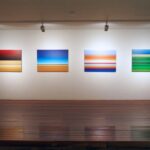 Collected Landscape – Solo Exhibition, Seo Gallery, 2006