작업노트
Artist's Note
작업노트
나는 나의 감각을 언어와 색채로 연결, 물리적으로 물감을 조색하고 그 물감으로 내가 느끼고 생각한 이 세계를 표현해 왔다. 색상의 명도와 채도를 명확하게 사용하면서 언어와 연결했던 지난 나의 작업은 내가 이해할 수 없는 이 세계를 해석하는 방법이었다. 그러나 지난 12년간 400여 개의 물감을 만들면서 형용사라는 언어의 한계와 그와 달리 무한한 색상 사이의 틈을 최근에 인식하기 시작했다. 또한 나는 지금 펼쳐지고 있는 나의 외부환경, 특히 인간이 만든 민주주의가 얼마나 허약한가를 실시간으로 전해지는 소식을 통해 보면서 여전히 나는 이 세계를 이해하기 어렵다고 느낀다.
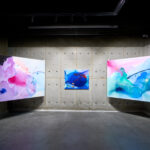
이런 인식에서 내가 지금까지 견고하게 지켜온 나의 규칙들을 모두 전복시키고 새롭게 확장하고자 [감각세계 Sinneswelt]라는 작업을 시도했다. 이를 위해 나는 형용사로 만든 색채의 명도와 채도를 물을 이용해 조절함으로써 우연이 색의 본질을 변화시킬 수 있도록 의도했다. 캔버스 위에서 펼쳐지는 사건은 나의 감정이 담긴 색의 자유로운 흐름과 우연의 상호작용 속에서 내가 인식한 세계에 대한 재정의, 혹은 재해석이다.
내가 생각하는 감각세계란 감각세계와 정신세계의 이분법적 구조가 아닌, 현 시대성을 반영하는 감각-의미라는 보다 넓은 해석(인간의 신체적 오감과 함께 언어, 사고, 자아, 사회적 감각 등)에 기반하고 있다.
[감각세계-부분 Sinneswelt-teile] 시리즈는 큰 세계의 일부분을 그리는 지엽적인 세계로 마치 우주의 어느 한 부분에서 현재 발생하고 있을 사건을, [감각 구성 Sinnliche Komposition] 시리즈는 그 사건을 기록으로 남긴 파피루스와 같다.
[과거에서 온 편지 Letter from the past]
이 작업은 일상의 감정을 색채–언어 단위로 전환하여 시간의 흐름을 시각적 지층으로 축적하는 회화적 실천이다. 매일의 정서 상태는 420여 개의 ‘형용사로서의 색채‘ 중에서 선택되며, 동일한 수평 형식으로 반복 누적된다. 이 과정에서 발생하는 미세한 변주는 규칙성과 우연성, 일상성과 개별성이 교차하는 리듬을 생성하며, 하나의 압축된 시간 구조를 형성한다.
작품은 ‘감정의 단위 시간‘이 중첩되며 생성된 시각적 층위이다. 이는 지질학적 지층처럼 과거의 흔적을 압축하여 평면에 퇴적시킨다. 개인의 서사는 언어–색채–평면이라는 구조적 틀 안에서 질서를 획득하며, 동시에 그 틀의 한계를 드러낸다.
화면 우측의 손글씨 형용사들은 감정 언어의 명확한 지시성을 갖지만, 그에 대응하는 색채는 언어적 명명의 불완전성을 시각화한다. 언어–감정–색채 사이의 번역 불가능한 간극, 즉 명명된 감정이 색채로 재해석되는 과정에서 발생하는 의미의 미끄러짐은 관람자에게 새로운 해석의 여지를 열어둔다. 이 작업은 감정의 기록이자 언어와 시각 사이의 번역 행위이며, 개인의 시간이 보편적 형식 속에서 어떻게 구조화되는지에 대한 탐구이다.
이번 전시에서 [상태변화 Emotional Color Change] 시리즈는 지난 2년간의 작품을 한쪽 벽면에 일렬로 배치했다. 하나의 작업을 위해 나는 현실 속에서 감성의 변화를 포착하고 형식과 구성을 통해 완성한다. 수개월에 걸쳐 완성된 각각의 작업을 나는 일렬의 집합체(Assemblage) 형식으로 전시함으로써 내가 경험했던 세계가 각기 다른 차이를 가졌지만 연속된 삶의 의미 있는 감각의 세계였음을 보여주고 싶었다.
2024, ⓒ 이 경
Artist's Note
Work Notes 2024
I have connected my senses through language and color, physically mixing pigments and using those paints to express this world as I feel and think it. My past work, which clearly employed the brightness and saturation of colors while linking them to language, was my way of interpreting this world I couldn’t understand. However, over the past 12 years, while creating over 400 paints, I have recently begun to recognize the gap between the limitations of language—specifically adjectives—and the infinite spectrum of color. Furthermore, witnessing the unfolding of my external environment, particularly the fragility of human-made democracy conveyed through real-time news, I still find this world difficult to comprehend.
From this realization, I attempted the work [Sinneswelt] to overturn all the rules I had steadfastly upheld until now and expand them anew. To achieve this, I intended for chance to alter the essence of color by using water to adjust the brightness and saturation of hues created from adjectives. The events unfolding on the canvas are a redefinition or reinterpretation of the world as I perceive it, emerging from the free flow of color imbued with my emotions and the interaction with chance.
My conception of the sensory world is not based on the dichotomous structure of sensory versus mental realms, but rather on a broader interpretation of sensory-meaning reflecting contemporary reality (encompassing human physical senses alongside language, thought, self, and social senses).
The [Sensory World-Parts /Sinneswelt-teile] series depicts a fragmentary world, a part of the larger world, like an event currently unfolding in some corner of the universe. The [Sensory Composition Sinnliche Komposition] series is like papyrus preserving a record of that event.
[Letter from the Past]
This work is a pictorial practice that converts everyday emotions into color-language units, accumulating the flow of time as visual strata. Each day’s emotional state is selected from approximately 420 ‘colors as adjectives’ and repeatedly accumulated in an identical horizontal format. The subtle variations that occur in this process generate a rhythm where regularity and contingency, dailiness and individuality intersect, forming a compressed temporal structure.
The work is a visual stratum generated by the overlapping of ‘unit time of emotion.’ Like geological layers, it compresses and deposits traces of the past onto the plane. Personal narratives acquire order within the structural framework of language-color-plane, while simultaneously revealing the limitations of that framework.
The handwritten adjectives on the right side of the canvas possess clear indexicality of emotional language, yet the corresponding colors visualize the incompleteness of linguistic naming. The untranslatable gap between language-emotion-color—the semantic slippage that occurs when named emotions are reinterpreted as colors—opens up new possibilities for interpretation to the viewer. This work is both a record of emotions and an act of translation between language and vision, an exploration of how personal time becomes structured within universal forms.
For this exhibition, the [Emotional Color Change] series arranges works from the past two years in a single row along one wall. For each piece, I capture shifts in emotion within reality and complete it through form and composition. By exhibiting each work, completed over months, as a linear assemblage, I sought to show that the worlds I experienced, though each distinct, formed a continuous, meaningful sensory world of life.
2024, ⓒ Lee Kyong
Related Exhibition